
Revisiting the Map: BRCA and the Future of Preventive Medicine

As I’ve mentioned here before, I carry a BRCA1 mutation. Recently I wanted to dive deeper into the BRCA ecosystem because I had a theory about how BRCA might intersect with the rapidly growing field of longevity science.
I wanted to see the same type of full ecosystem infographic maps I’ve been seeing since the early 2010s in technology (AI, ML, data). I’ve always liked fitting complex landscapes onto a single page. It forces clarity, condenses thinking, and helps reveal relationships that might not be obvious in a paper or presentation.
I wanted to see BRCA the same way.
I couldn’t find a map like that.
So I built one.
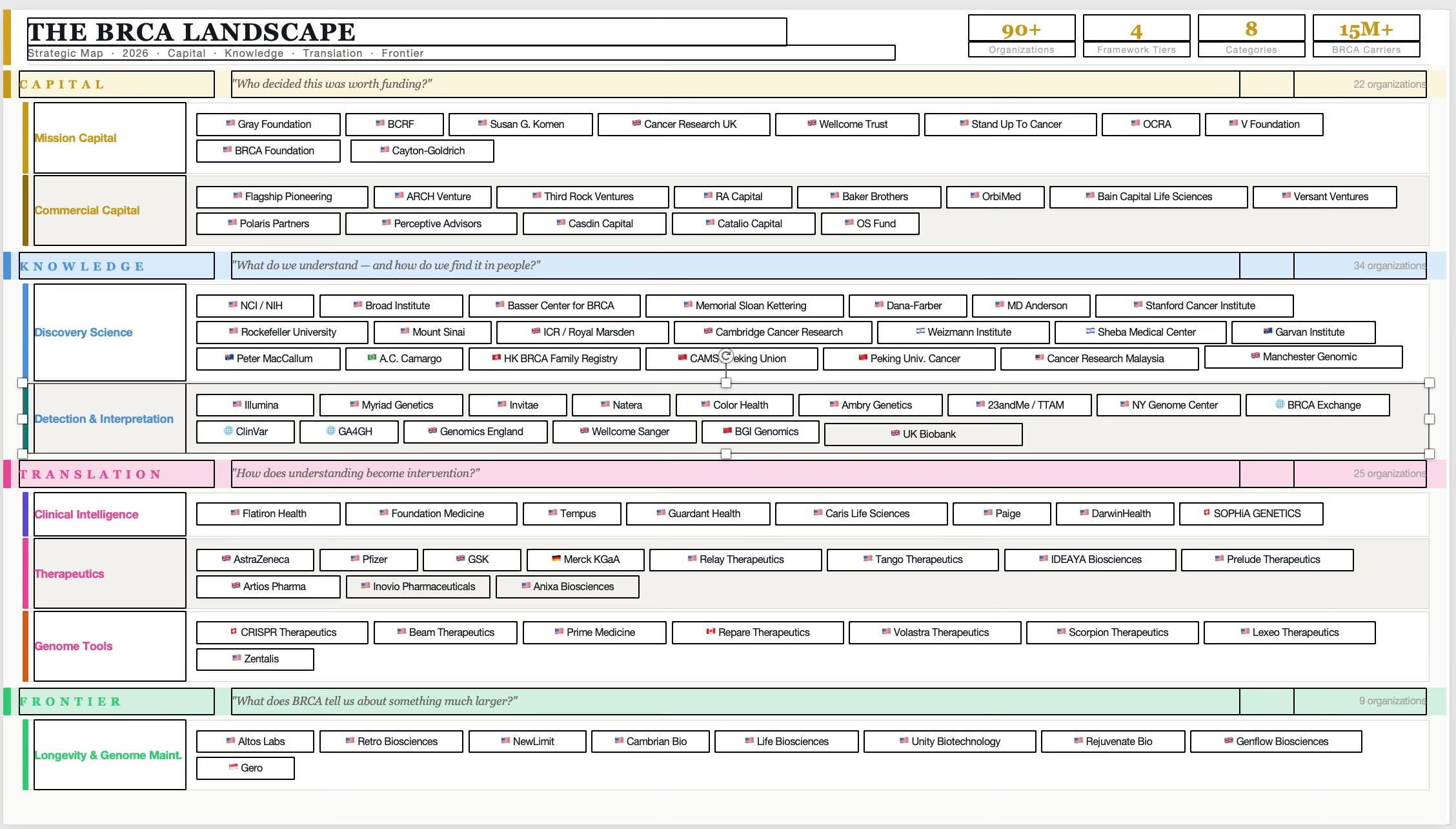
To really understand what I was mapping, I had to go much deeper than the infographic itself. So I wrote a short paper as well, which I’m sharing below for anyone who wants the full picture. For a one-page map, this took a surprising amount of time and research, even with AI as a research partner.
What the work clarified is this.
BRCA1 and BRCA2 are part of the cell’s DNA repair system. When those genes function normally, they help repair dangerous breaks in DNA. When a harmful mutation disrupts that repair process, genetic damage accumulates over time and cancer risk increases significantly. Roughly 1 in 100–200 people carry a pathogenic BRCA mutation, though many remain undiagnosed.
That population has several characteristics that make it unusual in medicine:
The biological mechanism is well understood: a defect in DNA repair
The population can be identified through genetic testing
Carriers are already accustomed to acting on risk before disease appears
Surveillance, preventive surgery, and other interventions are routine decisions in this community
Acting on probability rather than waiting for certainty is not theoretical here. It is already part of the medical reality.
That last point is what connects BRCA to something much larger.
Over the past few years, billions of dollars have begun flowing into companies trying to understand the biology of aging, specifically, how genome stability and cellular repair systems decline over time and what might be done about it. Altos Labs launched with roughly $5 billion in funding. Retro Biosciences raised $180 million. NewLimit is exploring epigenetic rejuvenation. In 2024, the most recent year with complete data, global investment in longevity companies reached $8.5 billion, more than double the year prior.
What most of these companies are chasing is exactly what BRCA mutations disrupt, the machinery that keeps DNA stable over a lifetime.
That overlap is the thing I couldn’t stop thinking about. Longevity science still struggles with a credibility problem. Many proposed markers of aging, methylation clocks and other biological indicators, remain proxies. They suggest something may be happening, but they don’t yet prove that human health outcomes have changed.
A genetically defined population with a measurable, well-characterized deficit in genome maintenance offers something stronger. It offers a place where interventions aimed at improving DNA repair could be tested against real outcomes, in people who already understand genetic risk and already act on it.
If longevity medicine’s central thesis is that restoring genome stability changes what happens to us as we age, BRCA carriers may be one of the clearest populations in which to find out whether that’s true.
This map is a first attempt to organize a complicated ecosystem into a single view. I’m approaching it from a technology and systems perspective, not as a researcher, though I also have a personal stake in the question. I welcome corrections or additions from anyone working more directly in the science.
I built it to understand the landscape myself. It felt worth sharing.
