
Individuals with Pathogenic Variants (Working Title)
We can now identify risk before disease. We haven’t agreed on what to call it, and that’s starting to matter.

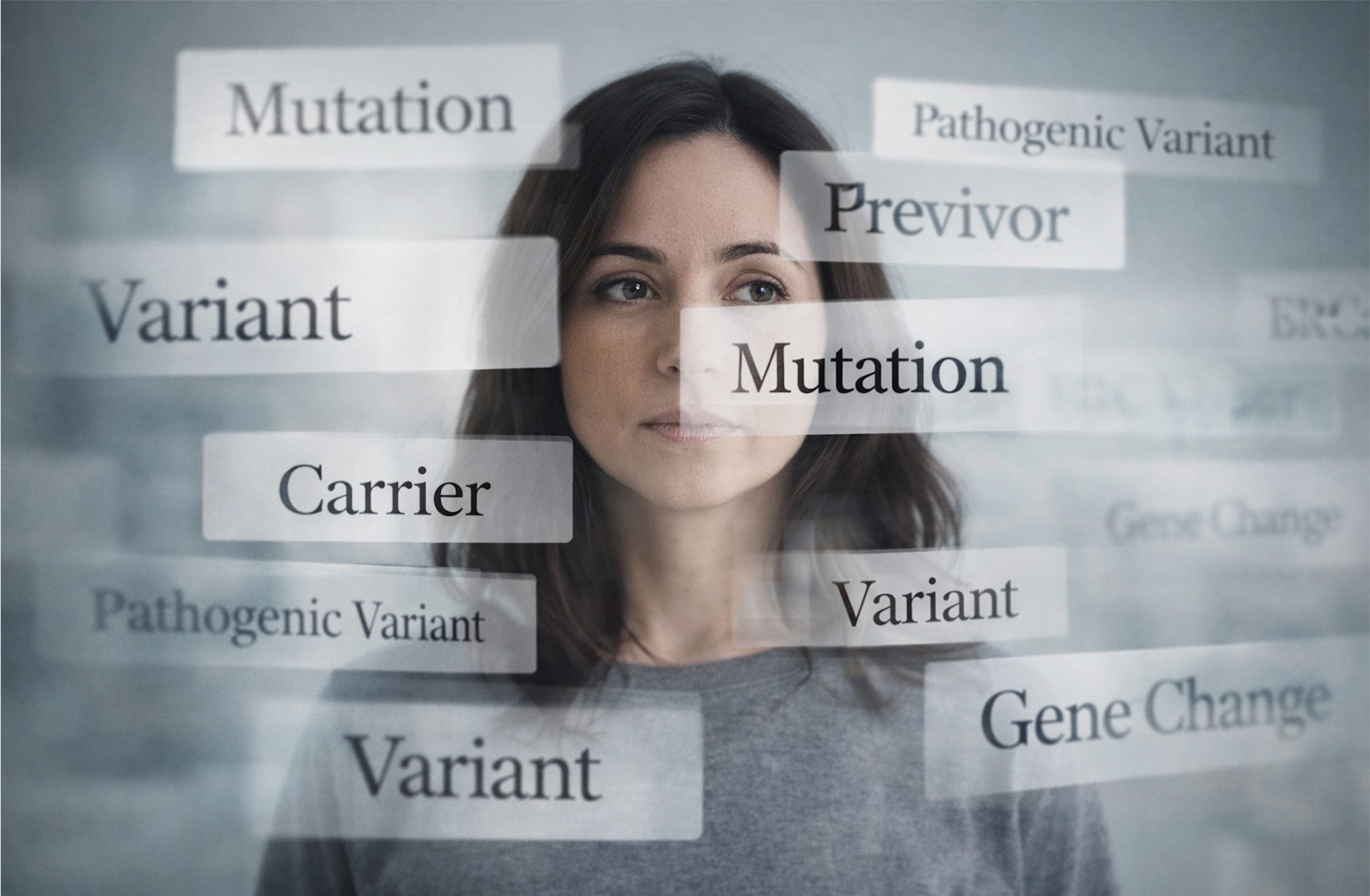
When I first got the results of a genetic test, I understood the headline: it wasn’t good. There were words: mutation, carrier, previvor, variant.
To clinicians, they are technically different things. To individuals, they mostly aren’t. At the time, they all meant the same thing to me.
I had bigger things to deal with. Decisions to make. Next steps to figure out. The words blending together weren’t consequential.
That changes later.
Over time, you realize you’ll be using these words constantly, with doctors, with family, with people who are genuinely curious. The language becomes part of how you explain a fact about yourself, and you want to do it and you justice.
And once you start thinking about this phase of your new life, it’s hard to ignore what’s happening more broadly.
Millions of hereditary cancer gene panel tests are now run annually, and the cost of reading a person’s DNA continues to fall at a pace that feels more like software than medicine. The impact is compounding. The science has moved quickly, but the language hasn’t kept up, and the downstream effects are accelerating quickly.
And now a growing number of people are trying to answer a question that sounds simple and isn’t: What, exactly, are we supposed to call this?
This isn’t a new question. The field has been debating it for years.
The Words
Once you start paying attention, you realize there isn’t just one word. There are many.
They get used interchangeably at first.
They’re not.
Mutation
This is usually the first one you hear. It sounds definitive. A little dramatic. Not in a good way.
There’s a reason for that. The word has been carrying cultural baggage for decades. Before it showed up in a genetic counselor’s office, it belonged to Marvel. X-Men. Mutants… something went wrong.
Except that’s not actually how biology works.
Everyone has mutations. Millions of them. Most don’t matter. Some are harmful. Some are beneficial. In some cases, they do both. Sickle cell is the textbook example. The same genetic change that can cause disease also provides protection against severe malaria. In parts of the world where malaria is common, that difference has been selected for.
So the word isn’t just about damage. It’s about difference. Sometimes that difference is risk. Sometimes it’s protection. Sometimes it’s both at the same time.
That complexity is exactly why the field tried to fix the language. In 2015, the American College of Medical Genetics and Genomics recommended replacing “mutation” with “variant,” with modifiers like pathogenic or benign to be more precise. It’s a better technical word perhaps, but it’s also not one most people use. Partly because “pathogenic variant” doesn’t exactly roll off the tongue. Partly because the first word you hear tends to stick. And partly because “mutation,” for all its problems, captures something the cleaner language doesn’t. It carries weight. It signals consequence.
That tension is exactly why the field moved toward “variant” in the first place.
And occasionally, it hints at the possibility that what looks like a flaw in one context might be an advantage in another. Ask the X-Men.
Variant
This is the word the field seems to prefer right now.
More neutral. More precise. Less loaded than “mutation.”
In 2015, the American College of Medical Genetics and Genomics recommended replacing “mutation” with “variant,” with modifiers like pathogenic, likely pathogenic, or benign to clarify what a change actually means.
Technically, it works. In practice, it gets complicated quickly. “Variant” softens the language, but it also flattens it. It doesn’t tell you whether something matters, so it almost always needs a qualifier. And that’s where “pathogenic variant” comes in. Accurate. Precise. Clinically useful. Also long. Technical. And not how most people talk. So people switch.
Doctors say “pathogenic variant.”
Patients hear “mutation.”
In conversation, it becomes “I have BRCA.”
The system has a preferred language. People have a usable one.
They’re not the same.
Carrier
This one bothered me more.
Technically, it has a specific meaning in genetics. It applies cleanly to recessive conditions, where someone carries one copy of a gene but isn’t affected themselves.
That’s not what’s happening here.
For conditions like BRCA, Lynch, or Huntington’s, people aren’t just “carrying” something irrelevant. They’re making decisions because of it. Screening. Surgery. Family planning.
But the word stayed. And maybe it works for some people. It didn’t for me.
It makes me feel like I’m transporting something. Like I’m carrying a disease, which I’m not.
So I don’t say it that way, carrier. I say: I have a BRCA1 gene mutation or variant. Sometimes I shorten it even more. I say: I have BRCA.
Most people understand, or think they do. Very few realize that everyone has BRCA1 and BRCA2 genes. The issue isn’t the presence of the gene. It’s the version.
That nuance gets lost quickly. And you do say it out loud. A lot.
That’s the part people don’t really think about at the beginning.
You don’t just hear the word once, you use it, over and over — with doctors, with family, with people who are genuinely interested. So whatever word you choose isn’t just descriptive. It’s repetitive. It becomes part of how you introduce this fact about yourself. Which means the language problem doesn’t stay static. It compounds.
Previvor
This one didn’t come from clinicians. It came from the community.
FORCE created the term because nothing else fit. The clinical label, “unaffected carrier,” didn’t capture what people were actually going through. “Previvor” combined predisposition and survivor, and for a lot of people, it works. It creates identity. Community. Something to hold onto.
That matters. At the same time, it doesn’t land the same way for everyone.
A friend of mine feels strongly about this. For her, it defines her by a disease she’s never had. It frames cancer as the destination she’s inevitably headed toward. And she’s noticed it doesn’t resonate the same way for men navigating these conditions, it grew out of a breast and ovarian cancer community with a specific culture that doesn’t necessarily translate across genders or across conditions.
That’s not a critique of the word. It’s actually evidence for the argument. When a single term can feel like a lifeline to one person and a verdict to another, when it lands differently across genders, across conditions, across cultures, that’s not a failure of the word. That’s a signal that the group is still becoming. That the identity hasn’t settled because the category hasn’t settled. And that gap has consequences that go well beyond what any of us call ourselves in conversation.
There isn’t one clean replacement sitting out there waiting.
When researchers directly tested this, asking parents, genetics professionals, and oncologists which term they preferred for a disease-causing genetic change, no single term won. Equal numbers of parents chose “gene change,” “altered gene,” and “genetic variant.” Clinicians liked “faulty gene” for its precision. Parents rejected it because it made them feel like they were faulty.
Clinical language is precise but distant. Identity language is powerful but not universal. Plain language is clear but inconsistent.
So what you end up with is what we have now: a set of words, all in circulation, none fully agreed on, all doing more work than they were designed to do.
Why It Matters
The obvious objection is worth naming: these conditions are clinically distinct. BRCA, Lynch, and familial hypercholesterolemia have different cancer profiles, different screening protocols, different treatment implications, and communities that have built hard-won expertise around exactly those distinctions. Collective identity doesn’t require erasing any of that. Rare disease proved it doesn’t have to.
At some point, this stops being about terminology. It becomes about power.
Because language doesn’t just describe a group. It defines who counts as one.
And that matters, because rights, protections, and resources don’t attach to individuals navigating this alone. They attach to groups that can be identified, measured, and recognized.
Without a shared term, there isn’t a clear group. And without a clear group, it’s harder to secure what follows — coverage decisions, employer policies, clinical guidelines, research investment, legal protections.
That’s not abstract.
BRCA alone affects roughly 1 in 200 to 1 in 400 people globally, depending on population. Lynch syndrome affects approximately 1 in 280. Familial hypercholesterolemia, 1 in 250. Taken individually, each of these looks like a niche condition. Taken together, they start to add up.
High-impact inherited variants across known conditions affect a few percent of the population. That’s tens of millions of people in the U.S., and into the hundreds of millions globally, before you account for moderate-risk variants or polygenic scores.
This isn’t a small group. It just isn’t organized like one, and without a shared name, it’s difficult to even see it as one.
And most of those people don’t know they are part of this group. Not because it’s rare, but because it hasn’t been widely tested or widely identified.
And without a shared name, it’s harder to see the group at all.
This isn’t the first time medicine has faced this kind of fragmentation.
Rare diseases followed a similar path. Thousands of conditions, each affecting relatively small populations, initially operated in isolation. Individually, they struggled to gain attention, funding, or policy traction.
Over time, they began to organize under a shared category. Organizations like the National Organization for Rare Disorders and EURORDIS helped create a collective identity that made the population visible at scale. That visibility led to policy changes, including the Orphan Drug Act, and a significant increase in research and therapeutic development.
It didn’t solve everything. But it changed what was possible.
Genetic risk populations are earlier in that process.
Today, they exist as separate groups — BRCA, Lynch, familial hypercholesterolemia, and others — each with their own language, communities, and advocacy. Organizations like the Gray Foundation, the Basser Center at Penn, and FORCE have built extraordinary infrastructure: research, clinical frameworks, community, and advocacy. The reason someone like me can receive genetic information, act on it, and then step back to think about how it’s all framed is because of the ecosystem they created.
Individually, these groups can look small. Collectively, they are not.
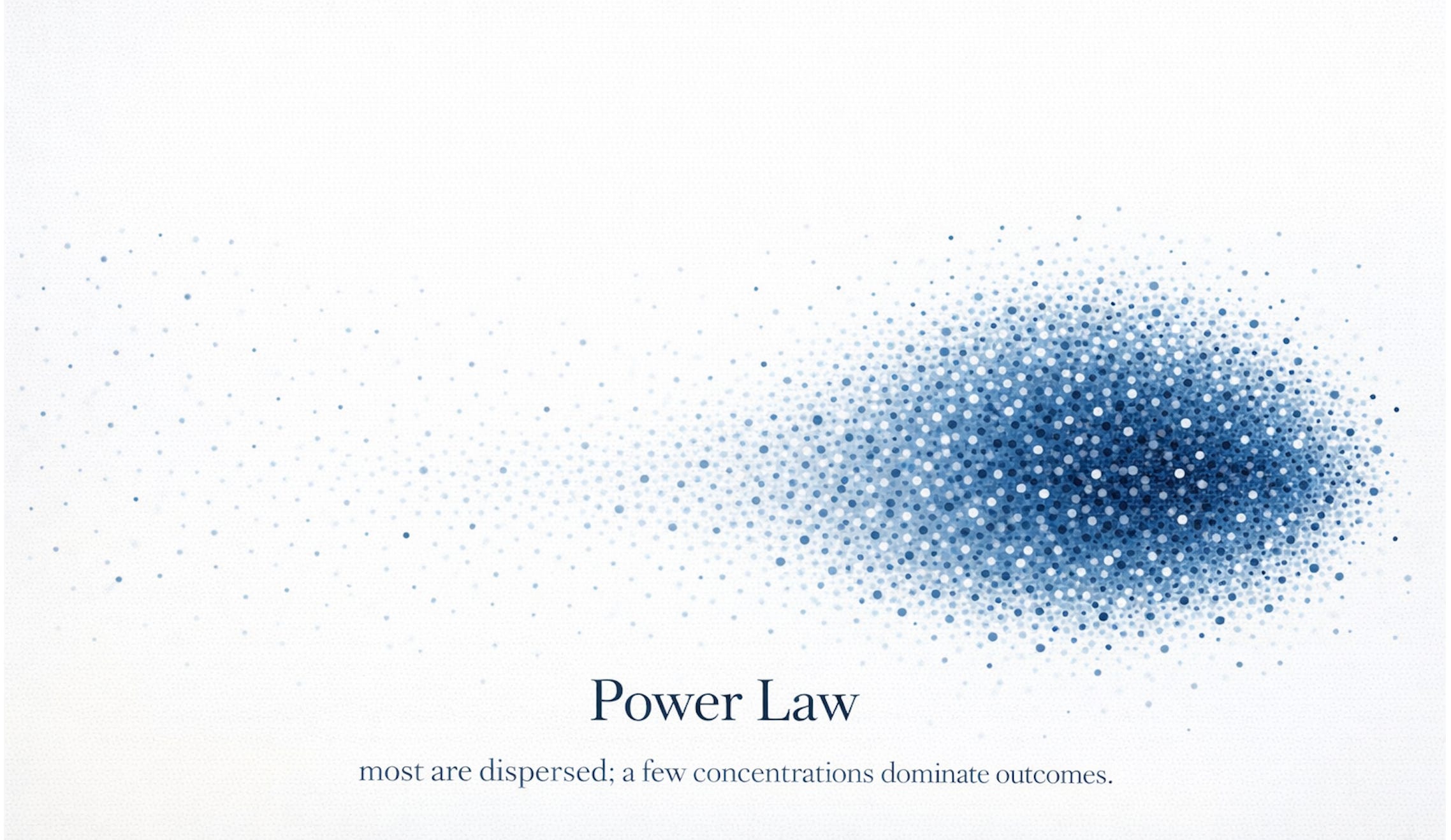
Scientists can now read almost all of a person’s DNA. But for much of it, we still don’t know what changing it actually does. In many cases, a test can tell you that something is different. It just can’t always tell you if that difference matters, or how.
That’s starting to change. As we learn more, more of those “we’re not sure” results become clearer, and more people move from not knowing to knowing they have elevated risk.
The DNA isn’t changing. What’s changing is our ability to understand it. Which means the number of people who know they are part of this group is going to keep growing.
Rare disease became visible when it became a category. Genetic risk hasn’t gotten there yet.
What looks like a terminology debate isn’t really about terminology at all.
It’s about whether a group exists.
Because language doesn’t just describe a population. It constitutes one. The moment a group has a shared name, even an imperfect one, it becomes possible to count them, study them, fund them, protect them, and build policy around them. Before that moment, they’re just individuals, each navigating something alone, using whatever word came to them first.
That’s where this population is right now. Not because the science isn’t there. Not because the numbers aren’t significant. But because we haven’t finished the sentence.
And that gap has a cost, one that is getting more expensive by the day.
In 2001, sequencing a single human genome cost nearly $100 million. Today it costs around $200. That is not a gradual improvement, that is one of the most dramatic cost collapses in the history of science. But the access story is only half of it. The more consequential acceleration is happening inside the science itself. AI and machine learning are doing in months what would have taken decades by hand: scanning millions of genomes simultaneously, identifying new pathogenic variants, reclassifying ones we thought were benign, and drawing connections between genes and diseases we didn’t know to look for. Variants labeled “uncertain significance” five years ago are being resolved. New links between known mutations and cancers, and conditions beyond cancer, are being established continuously. The map is being redrawn in real time. And when quantum computing arrives in genomic analysis, the pace of discovery may leapfrog again. Which means this population isn’t just growing because testing is cheaper and more accessible, it’s growing because the science keeps finding more to find. Every month, the circle of what counts as a known, actionable pathogenic variant gets wider. The group is enlarging not linearly but exponentially, while the language, the policy, and the infrastructure are still moving at the old speed.
Most people in this situation end up using all of these words. Clinical language with doctors. Plain language with family. Identity language in community. Switching depending on who’s in the room and how much you feel like explaining.
It works. Until it doesn’t. Until you realize you’ve been translating yourself for years, and the translation is exhausting, and somewhere in that exhaustion there’s a signal worth paying attention to.
Rare disease didn’t become a policy category because someone solved the science. It became one because enough people decided that fragmentation was costing them something, funding, attention, protection, and that a shared identity, however imperfect, was worth more than individual precision.
That reckoning is coming for genetic risk populations. The science is decades ahead of the social infrastructure. The testing is already happening. The numbers are already significant. The people are already here.
The question isn’t whether this group will eventually become visible. It’s whether they’ll have a hand in deciding what they’re called when they do.
That part hasn’t been written yet.