
Human Possibilities
The science of editing embryos is advancing in plain sight. Who is doing it is not.

BIO 2026 closes in San Diego today. For four days the largest biotechnology convention in the world put its best on display, with a great deal of artificial intelligence on the main stage. It was the field at its most visible.
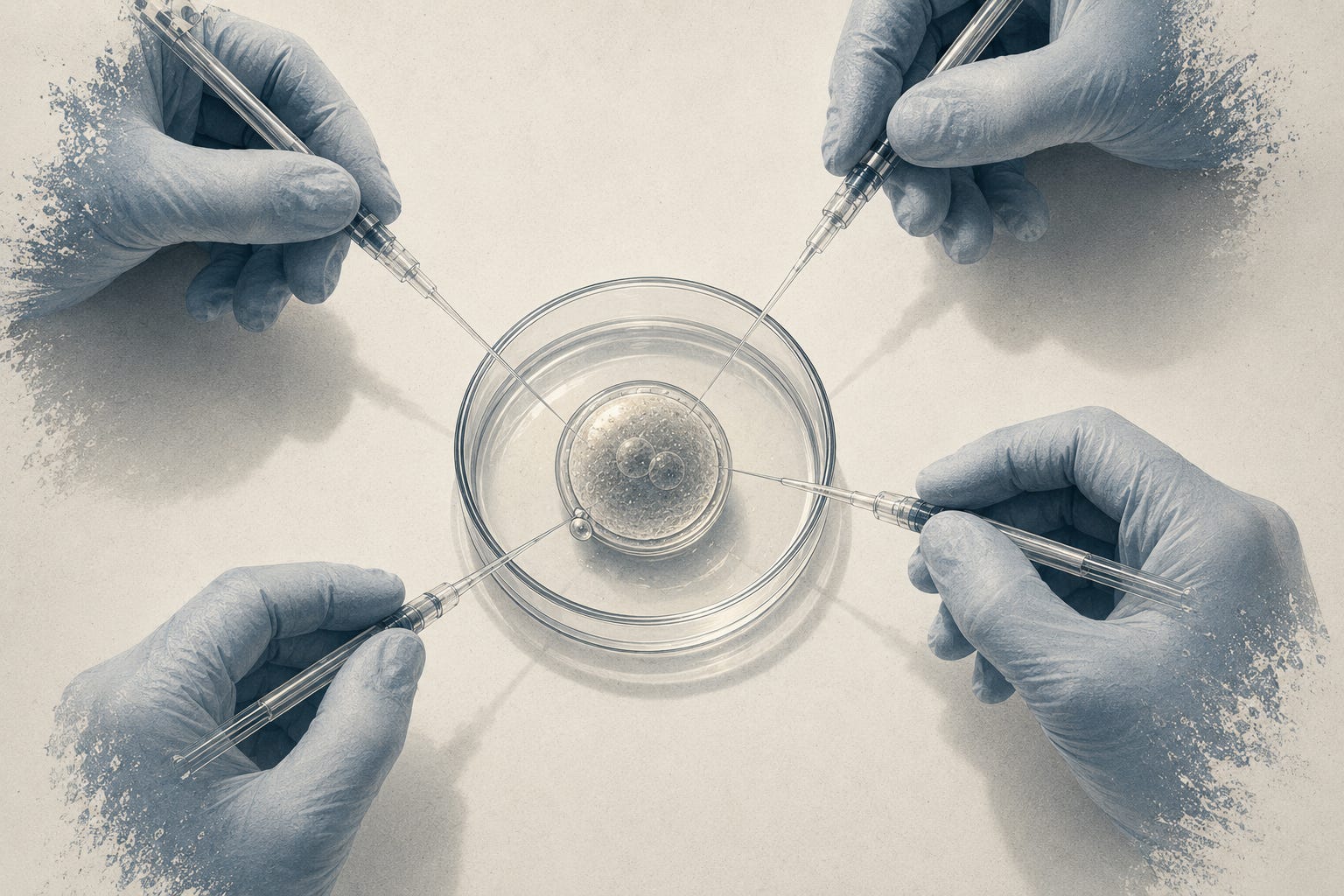
Away from the convention, a quieter conversation had been building all month. On June 1, a team led by Dieter Egli at Columbia posted a preprint, a study shared publicly before peer review, showing that base editing, which changes a single letter of DNA without the double-strand break that standard CRISPR makes, could edit disease-related genes in human embryos with far less of the chromosomal damage that made earlier attempts unusable. Egli was careful, and said plainly that the work was nowhere near ready for a clinic. Later that month, Paul Knoepfler, a stem cell biologist at UC Davis, used a column in STAT to renew a call he has made for a decade, that heritable human gene editing needs a temporary moratorium until guidelines exist. The loud news was about reading biology faster. The quiet news was about writing it into a person.
Gattaca is about a world already sorted this way, and one scene shows how the sorting begins. A counselor sits with two parents, and in a single short conversation moves them from preventing disease to screening out predispositions, baldness, myopia, alcoholism, a tendency toward violence, and when they hesitate and say they would be comfortable preventing illness but wonder about leaving a few things to chance, he answers in one line, we want to give your child the best possible start. The move from curing disease to choosing the best version of a child takes one conversation. When it is your own child, wanting the best for them is the most natural feeling there is.
Best begins as a word about health, the absence of disease, which almost anyone would agree on. It does not stay there. A disease can sometimes come down to a single letter of DNA, as sickle cell does, the kind of target a precise edit can reach. The traits a parent reaches for next are not like that. Height and intelligence are real, and they matter, but they are spread across thousands of genes and answer to no single edit, and what reaches them is not editing but selection, scoring embryos and choosing among them, which moves the odds a little and guarantees nothing. Best is not a medical fact. It is what the culture has taught a parent to want, running ahead of what the science can do.
So a respected scientist calls for a moratorium. A moratorium is closer to a gentlemen’s agreement than to a law. A field agrees to hold off, which sounds responsible and makes for good public discourse, and it has no teeth. The field had already tried. A little over a year before the preprint, three of its own organizations, the American Society of Gene and Cell Therapy among them, called for a ten-year hold on heritable human genome editing, including the editing of embryos. The embryos were edited anyway. The society’s chief executive called the work unfortunate and said it flew in the face of the moratorium, and that statement was the whole of the consequence. A moratorium binds the people already inclined to be careful and is quietly ignored by everyone else.
The call comes at a particular kind of moment, when a technology could change the species or end it. Recombinant DNA was there in 1975, when biologists stopped their own riskiest experiments and met at Asilomar, a conference center on the California coast, to write the rules themselves. It is thought to have worked because the field was small enough that everyone who mattered knew one another, the work stayed in laboratories, no fortune waited for whoever moved first, and the people who could have broken the agreement were the ones who wrote it. None of that is true now. The field is global, the work is commercial, and an agreement reaches only the people who sign it.
Screening already lets parents using IVF avoid passing on most single-gene diseases by selecting an unaffected embryo, so for most couples editing adds nothing medical, except in the rare case where no healthy embryo exists. That is why Fyodor Urnov, a gene-editing scientist at Berkeley, called editing embryos to treat disease a solution in search of a problem. If there is no disease need, he argued, the real use will be enhancement, making a child better rather than healthier, which he called baby improvement. What a parent wants for a child is personal, the reward for being first is large, the methods are published for anyone to read, and a ban in some countries and not others does not stop the work so much as tell it where to go. He Jiankui made the first gene-edited babies in 2018, and the people closest to the field were not entirely surprised, the rumors had circulated for some time.
The one technology of this scale that humanity has slowed, nuclear weapons, was not slowed by asking everyone to wait. It was slowed by watching, by inspectors and monitoring, and even then only where someone was looking. A heritable edit is harder to watch than a reactor, because it needs a lab, a clinic, and money rather than rare materials and vast facilities. The convention spent the week celebrating the field’s growing power to read the genome. The harder task now is to see the world forming around the ability to write it - the scientists, clinics, investors, parents, and countries moving at different speeds and for different reasons. A moratorium can express a shared limit, but it cannot create the visibility needed to hold one. That will require something the field has not yet built, a way to see itself clearly enough to govern what it is becoming.